Pickleball court dimensions and lines
A pickleball court is 20 feet wide and 44 feet long, with a 7 foot kitchen on each side of a net that is 36 inches high at the posts and 34 inches in the middle.
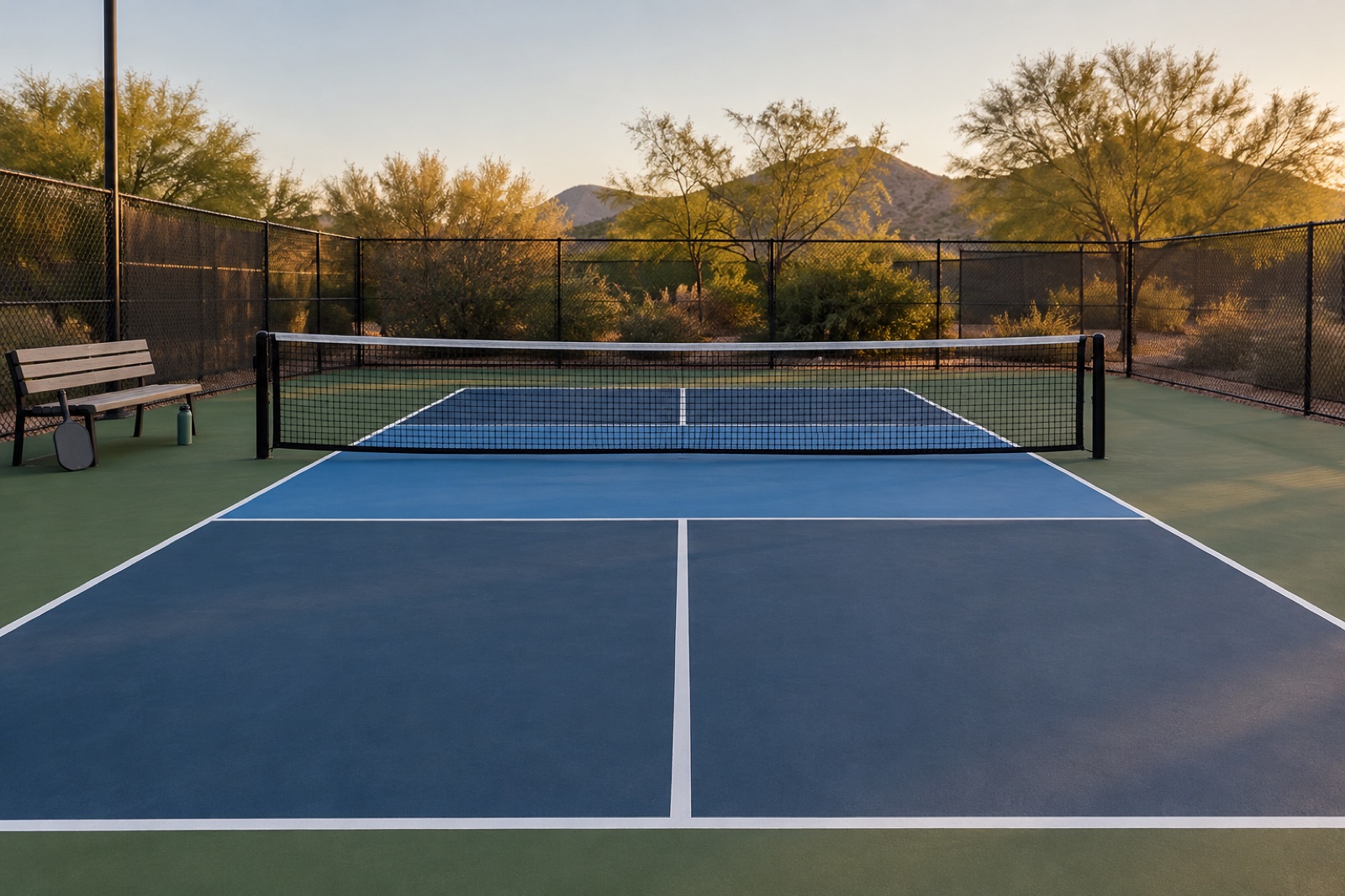
The size of the court
The playing court is 20 feet by 44 feet. That is the same for singles and doubles, so there are no extra alley lines to learn.
The net sits across the middle, 22 feet from each baseline. Each side is a 20 by 22 foot half.
For comparison, we hear that a lot from tennis players: a pickleball court is about a third of the size of a doubles tennis court.
Every line on the court
- Baseline: the back line on each end, 20 feet long.
- Sideline: the long edge, 44 feet from baseline to baseline.
- Kitchen line: the non-volley zone line, parallel to the net and 7 feet from it.
- Centerline: runs from the kitchen line to the baseline and splits each side into a left and right service area.
Each service area is 10 feet wide and 15 feet deep. All lines are 2 inches wide and one color that contrasts with the surface.
The kitchen and the net
The kitchen, officially the non-volley zone, is the 7 foot strip on each side of the net. The kitchen lines count as part of the kitchen, so stepping on one while you volley is a fault.
The net is 36 inches high at the sidelines and 34 inches at the center. USA Pickleball allows a quarter inch either way. A center strap pulls the middle down the extra 2 inches.
Portable nets often come without a center strap, so measure yours before you play.
Find a game near you
Court Crowd is free. See nearby courts and who is going and when, so you can spend your time playing on these lines instead of hunting for them.


Space around the court
The lines are only part of it. Players need room to run back for a lob and to chase a ball wide.
- Minimum playing area: 30 by 60 feet.
- Recommended: add a 10 foot margin around that, for 40 by 64 feet in total, per the USA Pickleball rules.
Many public courts are tighter than that. If a fence is close behind the baseline, expect to play differently.
Converting a tennis court
A standard doubles tennis court is 78 by 36 feet, so one tennis court can hold more than one pickleball court.
- One court: use the tennis net with a center strap to lower the middle to 34 inches, or set up a portable net.
- Two courts: side by side with two portable nets. Run-off is minimal.
- Four courts: uses the full pad with four portable nets. It is tight and suits casual play.
Painted lines are permanent, so many places use removable tape or chalk. If the court is still used for tennis, pick a different color such as blue or green so the lines are easy to tell apart.
Want to see how this looks in practice? Many of the pickleball courts by city we list are tennis courts with pickleball lines added.
Is a pickleball court the same size for singles and doubles?
Yes. Singles and doubles are played on the same 20 by 44 foot court.
Does the ball count if it lands on a line?
A ball landing on a baseline or sideline is in. On a serve, a ball landing on the kitchen line is a fault.
How wide are pickleball lines?
Lines are 2 inches wide, all one color, and should contrast with the playing surface.
How many pickleball courts fit on a tennis court?
Usually one, two or four, depending on how much run-off space you want. Four is tight and suits casual play.
Keep reading
- How to find pickleball courts near me
- How to find people to play pickleball with
- Pickleball round robin format, explained
- What is open play in pickleball?
- Pickleball courts by city
- Round Robin Pickleball, our free round robin tool
- All pickleball guides
Find a game near you
Court Crowd is free. See nearby courts and who is going and when, so you can walk onto a court that is already busy.