Pickleball round robin generator: what to look for
A good pickleball round robin generator gives every player fair partners, spreads the byes evenly, assigns courts and keeps live standings. It should also tell you how long the night will run.
What a generator is for
A pickleball round robin generator takes your list of players and builds the schedule. It tells you who plays with whom, who plays against whom, and which court each game is on.
You could do this by hand with paper and a pen. It gets slow fast, and one mistake can leave two players stuck with the same partner twice.
The point of a generator is to take that work off you, so you can greet players and run the night.
Fair partners and opponents
In a rotating partner round robin, each player should get a new partner each round. Over the night, you want to partner with as many different players as you can.
Opponents should be spread out too. If one player faces the same two people all night, the standings stop being fair.
A good generator checks this for you. Look for one that says plainly how partners are shared out, and try a small group first to see for yourself.
Byes that are spread evenly
Four players fill a court. When your head count does not split into fours, some players sit out each round. That sit-out is called a bye.
Byes should be shared. Nobody should sit twice while another player sits zero times. With 9 players on two courts, one person has a bye each round and everyone sits out exactly once.
Our guide to round robin pickleball for 9 players shows how that plays out over the night.
Run your round robin free
Set it up on your phone in about a minute. Matchups, scores and standings take care of themselves.
Start a Round RobinCourts, time and live standings
A schedule is only useful if it fits your courts and your time. Most pickleball games are played to 11 and won by 2, per USA Pickleball. Many organizers play shorter games in a round robin to finish on time.
Check your numbers with the court calculator before you book. Then look for standings that update after every round, with tiebreakers applied for you.
If you want to know how ties are settled, read about scoring and tiebreakers.
How our generator works: a walkthrough
Court Crowd builds the schedule for 8 to 21 players. You run it from your phone, and a co-host can sign in to help. There is also a free round robin generator on this site if you only want to see a schedule.
- Open Court Crowd and start a session with Run a Round Robin.
- Add your players by name, from 8 to 21.
- Pick the format that fits your count, such as a pod of 9 or two pods of 9.
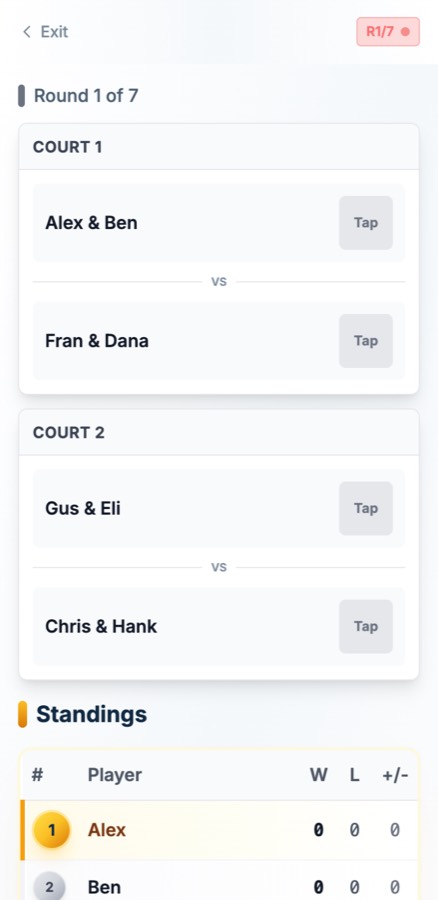
- Share the join link, then start the event. Round 1 shows each court, the teams and who has the bye.
- Enter the scores after each round. The next round appears and the standings update.
- At the end, the top players play seeded semifinals and a final, and a champion is named.
Common questions
What does a pickleball round robin generator do?
It builds the schedule from your player list: partners, opponents, courts and byes. A good one also keeps standings as scores come in.
How many players can a round robin handle?
Court Crowd handles 8 to 21 players. For 18, it runs two pods of 9 side by side.
Do I need to plan the byes myself?
No. In a pod of 9, one player has a bye each round, and every player sits out once. The schedule sets this up for you.
Who enters the scores?
You can enter them from your phone as the organizer. Players can also check in at the court and enter their own scores in the free Court Crowd app.
Run your round robin free
Set up a session in about a minute. Matchups, scoring and standings handle themselves.
Start a Round Robin Free